 |
 |
 |
 |
 |
|
 |
|
 |
|||||||
|
|
|
|
|
|
|
|
|
|||||||
“Those who ignore history, are condemned to repeat it.”
George Santayana
 Paul Gosselin (13/3/2026)
MacIntyre's book examines critical shifts in the West's political landscape and provides much useful material on the real and growing neototalitarian trend. MacIntyre efficiently exposes both parallels and discontinuities with 20th century totalitarianism. One symptom of the neototalitarian trend appears in American politics, when postmoderns realize that political processes may take away their power, make open threats of violence. This is evidence, not only of an attitude of entitlement, but a clear rejection of democracy as well. Another way of putting it would be: "Democracy is acceptable or legitimate only if we're in power!". One other symptom of this trend are progressive individuals publicly fantazing about their political oppenent's death... The (not so) implicit view being expressed is that if masses do not vote them in, then this can be disregarded and other ways to maintain power can be found (and exclude undesirables). Such behaviour demonstrates that in their view, wielding political power is their absolute right... Lawfare, political violence and tampering with election results are then legitimized. Outside the US I suspect the attitudes are the same, but elsewhere the postmodern's grasp of power is less contested and as a result, open threats of violence (or actual violence) is generally not needed to maintain their power.
The Postmodern Inquisition
If liberty means anything at all it means the right to tell people what they do not want to hear.
George Orwell (Preface to Animal Farm)
Another symptom of the trend towards totalitarianism is the growth of censorship in the West. As MacIntyre points out, more and more Western leaders see freedom of speech as a “problem”, particularly on the Internet which clearly has been a gamechanger regarding the reach of individual free speech (2024: 6)
This is a huge problem for those who have carefully cultivated power. When dissident opinions were shared privately between friends, or even shouted on a street corner, they could be largely ignored. Such upstarts didn't have enough reach and could easily be dismissed as cranks. When the same opinions were printed on a pamphlet, that might be a little more concerning, but they could still be drowned out by the firehose of propaganda the elite could turn on the public through the mainstream press. With every citizen able to instantaneously communicate his opinions on a mass scale, the threat posed to elites who rely on popular sovereignty for power was substantial. New methods had to be deployed.
Because many Western elites see freedom of speech as a “problem”, to avoid their censorship initiatives being too clearly linked in the public's mind with the Spanish Inquisition or the Soviet KGB, they then resort to framing their efforts at Internet censorship in terms of combating disinformation. But this is a bogus strategy because if you claim to engage a battle against disinformation, then this is evidence you are promoting a concept of Truth... Which immediately raises the questions: What is your "Truth" and where did you get it? What is your ideological reference point? Lay your cards on the table! But postmoderns would rather fry in Hell than do that... Things must remain confused. Thus when asked "What is your Truth", they will inevitably change the subject.
As MacIntyre notes, censorship on the Internet is just one piece of the puzzle. Postmodern elites have added to the mix many forms of cancel culture and lawfare, some of which will directly threaten an individual's livelihood. These methods have been found useful to discredit, shut down and marginalise annoying dissidents. The basic issue of course is driving dissidents out of any place of influence, whether it is a teacher resisting the LGBTQ agenda, a dissident researcher doing a conference on a university campus or a doctor questioning Covid vaccines. In some instances harassment from a loud and intimidating group of AntiFa barging into a conference will do the trick and get everything cancelled. But that's not always how it works out. The Charlie Kirk episode demonstrated that if you are too effective at disrupting the official narrative (especially if you can reach the upcoming generation), then assassination is not out of the question... The ultimate cancellation in effect...
One novel censorship strategy noted by MacIntyre is the weaponization of medicine or therapy (2024: 101)
The process of medicalization quickly bleeds over into the political realm. Cable news shows are flooded with medical experts who diagnose their political opponents with mental illness or limited cognitive capacity. In the total state, there can be no competing moral values, no cultural differences, no alternative conclusions. Anyone disagreeing with those conclusions cannot have arrived at their position thought any kind of valid reasoning. Disagreement is a clear indication of mental illness, and not one of the approved mental illnesses that deserve sympathy and understanding, but one of the dangerous mental illnesses that make the dissident evil and a social pariah. The wrongthinkers are not rational individuals with valid concerns; they are racists, sexists, bigots who can be safely discarded.
During the Covid plandemic a number of doctors and scientists daring to question the official narrative were arrested and locked up in a psychiatric wards. For example, in December 2020, the French government had the dissenting professor of Pharmacology Jean-Bernard Fourtillan arrested and locked up in a psych ward as he had dared criticize the Covid narrative[1]. It should be noted that these are EXACTLY the same methods the Soviet KGB used to shut down dissidents during the Cold War. This is how totalitarian regimes suppress dissidents... Another angle of progressive censorship is the creation of organisations or laws to combat "Hate Speech", which stripped of all hypocrisy, are in fact nothing more than tools to suppress speech that postmoderns hate. In effect, the expression "Hate Speech" says nothing about the accused, but much about the accuser.
A further angle of Postmodern censorship is the deliberate attempt to terraform Western culture, obsessively editing out inconvenient perspectives and banned ideologies found in literature, movies, etc[2]. This is a concept clearly drawn from Orwell's 1984 novel, with a Ministry of Truth rewriting culture and history[3] to conform to the reality created by Big Brother. Orwell depicts this process as we follow the character Winston at his job at the Ministry of Truth (1949/2020: 31)
As soon as all the corrections which happened to be necessary in any particular number of the Times had been assembled and collated, that number would be reprinted, the original copy destroyed, and the corrected copy placed on the files in its stead. This process of continuous alteration was applied not only to newspapers, but to books, periodicals, pamphlets, posters, leaflets, films, sound tracks, cartoons, photographs—to every kind of literature or documentation which might conceivably hold any political or ideological significance.
Writing briefly after the publication of Orwell's 1984 it is possible the poet and playwright TS Eliot may have drawn on Orwell's concepts and applied them to education. Eliot clearly understood that word-games, such as those used by our postmodern elites, can lead to manipulation and cultural terraforming (1965/1991: 90)
Education for citizenship, then, seems to mean first of a the developing of social conscience; and I have already suggested that 'social' conscience can only be a development of 'conscience': the moment we talk about 'social conscience' and forget conscience, we are in moral danger-just as 'social justice' must be based upon 'justice'. The separation in our minds which results simply from dwelling constantly upon the adjective 'social' may lead to crimes as well as errors. In the name of social justice we can excuse, or justify to ourselves, or simply ignore, injustice: in the name of social conscience we can do the same by conscience. The same sort of substitutions can occur with the word 'democracy'. 'Social democracy' sounds at first a phrase to which no one could object ; but the denotation can be so manipulated that it can be made to point to something which to most of us, I think, may be anything but 'democratic'.
The demon Screwtape, in CS Lewis' Screwtape Letters (1942) looks at the motive behind Postmodern cultural terraforming (1974: 139-140)
Only the learned read old books and we have now so dealt with the learned that they are of all men the least likely to acquire wisdom by doing so. We have done this by inculcating the Historical Point of View. The Historical Point of View, put briefly, means that when a learned man is presented with any statement in an ancient author, the one question he never asks is whether it is true. he asks who influenced the ancient writer, and how far the statement is consistent with what he said in other books, and what phase in the writer's development, or in the general history of thought, it illustrates, and how it affected later writers, and how often it has been misunderstood (specially by the learned man's own colleagues) and what the general course of criticism on it has been for the last ten years, and what is the "present state of the question". to regard the ancient writer as a possible source of knowledge — to anticipate that what he said could possibly modify your thoughts or your behaviour — this would be rejected as unutterably simple-minded. and since we cannot deceive the whole human race all the time, it is most important thus to cut every generation off from all others; for where learning makes a free commerce between the ages there is always the danger that the characteristic errors of one may be corrected by the characteristic truths of another. But thanks be to our father and the Historical Point of View, great scholars are now as little nourished by the past as the most ignorant mechanic who holds that "history is bunk".
The Invisible Religion
MacIntyre proposes that the belief system shaping Western elite's views and interventions is what he calls “progressivism” or in other cases he uses the expression “decentralized atheistic theocracy”. I prefer the term “postmodern”, but more on that below... MacIntyre takes a stab at examining how this works and how this differs from previous arrangements in the past when Christianity had more influence (2024: 15)
As odd as it sounds, we are governed by a decentralized atheistic theocracy. A religious system without an official holy book or central church, but a religious system of moral assumptions all the same. It is particularly difficult for Americans to perceive this due to our understanding of the public/private distinction. We are trained to think that formal power, officially centralized under the law by government, is the only path to tyranny. If power is distributed among non-state actors, it is thus difficult for Americans to see this as a threat. This is understandable as the [American] founding fathers never envisioned a secular society where the entire ruling class received moral instruction exclusively from progressive universities before taking jobs that allowed them to deliver a narrative to a small box in every American's pocket 24/7, but this is the world we live in.
MacIntyre is quite right that as a totalitarian ideology, progressivism is a very different beast than 20th century totalitarian ideologies such as Nazism or Communism. Nazism and Communism were both very open about being coherent ideologies. Centralization of power was a key trait of both these ideologies. MacIntyre is right that Nazism and Communism have become entrenched in Western intellectual life as THE exemplars of totalitarianism. Unfortunately many educated individuals have become fixated on these cases and are unable or unwilling to grasp that totalitarianism may have evolved since the 20th century. Whereas modern ideologies derived from the Enlightenment, such as Nazism or Communism, still had explicit creeds such as the Communist Manifesto, Hitler's Mein Kampf, or the Humanist Manifesto, postmoderns are VERY careful NOT to lay their cards down on the table. In my view this is a deliberate attempt to provide their worldview with a bogus aura of “neutrality” and shield it from criticism. Chapter 3 (The Phantom Creed) in my Flight vol. 1 identifies and lists core postmodern beliefs (basically providing a “Shorter Postmodern Catechism”). On his X account MacIntyre points out one advantage of progressivism has as an invisible religion (2024b)
Without a holy book or a formal deity progressive humanism (wokeness) was able to evade the formal separation of church and state. Displaying the 10 commandments becomes a violation of civil rights law but worshiping the pride flag is fine.
MacIntyre is correct in pointing out that operating as an explicit ideologico-religious system would immediately exclude progressivism from State power in the US. Regarding progressivism as a social perspective, MacIntyre nails its divide and conquer strategy (2024: 22)
By dissolving the bonds and obligations of family, tribe, and religion, the ruler can make his subjects entirely loyal to and dependent on the state.
MacIntyre points out how progressivism is wedded to the LGBTQ+ agenda and explores one social repercussion (2024: 24)
There is a reason why every organ of power in the United States seems obsessed with introducing sexual and gender identity to children at an increasingly young age. Normalizing the idea of transexual children is an incredibly useful tool for the regime because it can serve as a reliable wedge between kids and their parents. If children can choose their own gender, if the ability to choose their gender is a human right, then it becomes the duty of the government to protect that right. Protect that right from whom, you might ask? The parents, of course.
While MacIntyre is typically interested in the political implications of such issues, there is one point here he seems to miss. Though many individual trans activists may be just aggressive, confused individuals, if one looks at the big picture and at the multiple social institutions backing trans propaganda[4] it may be of use to ask if there might be a likely political motivation for this propaganda? Consider this, if you have managed to get a large percentage of a population confused on such a BASIC matter as one's sexual identity then that population will be much easier to manipulate... From our postmodern elite's perspective this may be a significant watershed moment as if you have pushed a large percentage of a population to confusion on such a BASIC matter, then perhaps you have pushed them to a point when they will believe literally ANYTHING...
A further point to be noted is that individuals who have gone through the education system, even picking up a university diploma (and with no other worldview reference point except a latent/unconscious postmodernism) will be very vulnerable to the neototalitarian agenda. To avoid any “It could never happen here” wishful thinking nonsense that Westerners may entertain about their democratic heritage, here are some useful eyewitness observations about how powerful a totalitarian agenda can be, sweeping through multiple social institutions in a progressive Western nation. These observations are drawn from the diary of Nazi officer Wilm Hosenfeld (republished in Władysław Szpilman's book The Pianist. (1946/2002 : 205)
And as Hosenfeld points out, Christians who cannot accept the marginalisation that comes with a concern for Truth and who follow the latest cultural fad or the opinions of the experts will inevitably fall for a totalitarian ideology.
The Decentralized Atheistic Theocracy = The Cathedral
One critical point that MacIntyre makes about the present day neototalitarian trend in the West is its decentralized nature. (2024: 69)
While the Cathedral is constantly advancing progressive ideology through education, cultural, and corporate institutions, its decentralized nature makes it far more difficult to pinpoint the source of totalitarian dogma. The ideological dictates feel more organic because they accumulate slowly and appear to emerge from the normal processes of the institutions around the citizen rather than being directly issued from an official organ of the state. By making a nameless, faceless, ever-shifting process the agent of totalitarian oppression, rulers can obfuscate the source of power and how it is actually applied. It is almost impossible to hold a process accountable, especially when the mechanisms of that process are easily manipulated by an unspecified ruling elite.
In effect, the neototalitarians in presently in power in the West have learned hard lessons from the failures of 20th century totalitarian regimes. Nazis and Communists relied on centralized political and military power and openly used brutal methods (Nazi concentration camps, Soviet show trials, KGB executions or Gulag or the Chinese Laogai) to crush dissidents. The problem is that from the victim's perspective such methods clearly identify the enemy attacking you. If the Gestapo or KGB beats down your door in the middle of the night, you KNOW who you're dealing with. There is no confusion. This allows the victims to gain moral clarity and organize some form of resistance. On the other hand, the New Totalitarians prefer to keep their victims confused... Manipulation and mind-control is typically more effective and less labour-intensive than brutal crackdowns. An algorithm won't beat down your door in the middle of the night. It'll even let you sleep in. Twenty-first century neototalitarianism wears a mask, is more hypocritical, more marketing-driven, more manipulative, yet when pressed, it can be just as violent... The situation we find ourselves in is like a man pushed into a boxing ring, fighting an invisible opponent. He continually takes hits, but can't see anything to fight back...
In my view MacIntyre is on target regarding the critical ideological role played by universities in what he calls The Cathedral. If one were to go 200 hundred years back in time, in the West, education generally was in the hands of Protestant or Catholic organisations. The worldview perspective was then explicitly Christian. Of course since the 19th century this has radically changed and the progressive/postmodern worldview is now dominant in education. Universities then were explicitly propaganda transmission institutions. Today they still are, though hypocritical progressive/postmodern elites love to pretend to be neutral. This shields them from revealing comparisons and serious critique. As MacIntyre points out, universities have become both access points to circles of influence as well as gatekeeping organisations filtering out undesirables... (2024: 85-6)
The ubiquitous nature of the mandatory college credential across bureaucratic institutions, both public and private, meant that universities became the primary centers of enculturation for almost everyone who held any position of power. The shared formative experience of university education instilled not only a moral framework that informed the decision making of the new ruling class, but a shared understanding of how organisations should be structured and operated.
As MacIntyre notes, The Cathedral is not a centralized organisation like the Soviet government under Stalin, but is fed by a network of like-minded technocrats working under the State or in various private organisations. The key concept here is like-minded, that is individuals in various circles of power sharing a common (typically unacknowledged) worldview. In most instances the effectiveness of the Cathedral does not require a cabal ruthlessly coordinating all activities, because in most cases the like-mindedness of the various agents insures effective and desirable outcomes without central coordination. This is something that the British journalist[7] Malcom Muggeridge, had figured out many years ago as he reflected on his experiences or working in print media (1977/1978: 51-52):
From the lowest dregs of the media, like Penthouse or Forum, to the dizzy heights of Radio 3 lectures on Milton's politics or Dante's imagery, from Steptoe and Son and Upstairs Downstairs to Clark's Civilisation and Bronowski's Ascent of Man, through the whole media gamut, there runs a consensus or orthodoxy which is, within broad limits, followed, and in some degree, imposed. Certainly, any marked deviation other than in terms of eccentricity - the 'Alf Garnett' syndrome, for instance - is at some point, or by some means, disallowed. At the same time, there is every reason to believe that this happens of itself. People are not hand-picked for this or that job because they fall in with the consensus. Nor are they, in any way that I know of, pressurised to fall in with it in the course of their work. All the same, they are consensus-orientated, if not -fixated. One way and another, I know a lot of people working in the media; on newspapers, magazines, in news agencies, in radio and television, and believe me, I should have the utmost difficulty in naming more than a handful whose views are not absolutely predictable on matters like abortion, the population explosion, family planning, anything whatever to do with contemporary mores, as well as aesthetics, politics and economics, who will not say more or less the same thing in the same words about say Nixon, or Solzhenitsyn, or apartheid, or Rhodesia.
So it turns out that the Cathedral has long had a choir capable of hitting the high and low notes, a choir renowned for singing in perfect unison and all devotedly singing from the same hymnal...
For those who haven't gotten their daily dose of conspiracy theorism, here is an interesting anecdote. In chapter 7, MacIntyre alludes to CS Lewis' Abolition of Man where Lewis predicted the rise of a technocratic totalitarianism coupled with an obsession with “reshaping Man”. Some may be aware that Lewis wrote a novelized version of this essay in his Space Trilogy, specifically That Hideous Strength, published in 1945. This novel introduces a further element regarding the rise of the totalitarian mindset as in the novel, Lewis associates the totalitarian ideology with secret societies, which in the West typically brings to mind Freemasons. In the novel, this takes the form of the NICE (or National Institute of Co-ordinated Experiments). Now typically any finger-pointing at Freemasons regarding their real-world influence makes people nervous and tends to be laughed off as conspiracy-theorism nonsense. Of course it may be quite tempting to write off Lewis' totalitarian – secret society allusion as nothing more than a flight of creative fancy, but it is odd to note that another respected Western intellectual writing during the same time period (and coming at these issues from an entirely different angle), came to a similar conclusion.
 In her magnum opus, The Origins of Totalitarianism (written immediately after WWII), the very rational political philosopher (and secular Jew) Hannah Arendt exhaustively examined 20th century totalitarian regimes, but "oddly enough" linked these regimes to secret societies. Arendt observed (1948/1976: 376-377):
The totalitarian movements have been called "secret societies established in broad daylight." Indeed, little as we know of the sociological structure and the more recent history of secret societies, the structure of the movements, unprecedented if compared with parties and factions, reminds one of nothing so much as of certain outstanding traits of secret societies." Secret societies also form hierarchies according to degrees of "initiation," regulate the life of their members according to a secret and fictitious assumption which makes everything look as though it were something else, adopt a strategy of consistent lying to deceive the non-initiated external masses, demand unquestioning obedience from their members who are held together by allegiance to a frequently unknown and always mysterious leader, who himself is surrounded, or supposed to be surrounded, by a small group of initiated who in turn are surrounded by the half-initiated who form a "buffer area" against the hostile profane world. With secret societies, the totalitarian movements also share the dichotomous division of the world between "sworn blood brothers" and an indistinct inarticulate mass of sworn enemies." This distinction, based on absolute hostility to the surrounding world, is very different from the ordinary parties' tendency to divide people into thosæe who belong and those who don't. Parties and open societies in general will consider only those who expressly oppose them to be their enemies, while it has always been the principle of secret societies that "whosoever is not expressly included is excluded." This esoteric principle seems to be entirely inappropriate for mass organizations; yet the Nazis gave their members at least the psychological equivalent for the initiation ritual of secret societies when, instead of simply excluding Jews, from membership, they demanded proof of non- Jewish descent from their members and set up a complicated machine to shed light on the dark ancestry of some 80 million Germans.
To avoid any misunderstanding, Arendt does not explicitly refer to Freemasons, but her comments do fit in quite well with what is known about the operating principles of Freemasons.[7a] Of course, delving into such matters is not for the faint of heart as the aura of mystery surrounding such organisations and the possibility of falling flat on one's face due a failure to distinguish between confirmed fact and rumor or fantasy (or even deliberate misinformation) may be enough to shut up even the most critical and rational among us. Noam Chomsky nailed how the fear of ridicule very efficiently plays out even among intelligent people (2005):
"If you're down at a bar... and you say something that people don't like, they'll... shriek four-letter words. If you're in a faculty club or an editorial office, where you're more polite — there's a collection of phrases that can be used which are the intellectual equivalent of four-letter words and tantrums. One of them is “conspiracy theory”... , [part of] a series of totally meaningless curse words, in effect, which are used by people who know that they can't answer arguments, and that they can't deal with evidence. But... they want to shut you up."
The Total State and Its progressive/postmodern worldview
In chapter 7 MacIntyre points out that the Total State (or postmodern totalitarianism) rests on the foundation of an “atheistic theocracy” (2024: 98)
A materialistic[8] worldview is another essential aspect of this atheistic theocracy. Science, by definition, cannot solve metaphysical problems. Everything must therefore exist on the material plane. Every aspect of the human condition must be the result of forces that are directly observable and quantifiable. This often requires a sleight of hand with the definition of science, or the creation of pseudoscientific disciplines, but these are acceptable compromises if they keep the narrative relatively coherent.
One critical issue that MacIntyre raises here about the Total State and it's atheistic theocracy is that this worldview “cannot solve metaphysical problems”. This is no small matter... More specifically, this worldview undermines any absolute moral framework. For this reason it is the ideal framework for a postmodern elite seeking total, absolute, and unlimited power... It should be pointed out that the Total State's worldview is NOT an abstract philosophical matter. It has very practical implications. Bluntly put, the Total State's worldview affects how our neototalitarian elites deal with us...
This is an issue that a number of Western intellectuals have given thought to over the years. In Fyodor Dostoevsky's most famous work, The Brothers Karamazov (1880, Chapter V: The Grand Inquisitor), he wrote, "If there is no God, everything is permitted." In other terms, if there is no absolute reference point for morals, then we can all do whatever we want. Early Enlightenment thinkers were aware of such critiques and complained that morals are natural and universal. In some instances Enlightenment devotees loudly protest that atheists can be moral persons too. But this claim (conveniently) confuses two separate questions: 1) Can a materialistic worldview provide a rational basis for morals? 2) if an individual atheist appears to be a moral person, which specific worldview provided said morality? To answer this second question, one must examine this atheist's life history and formative influences. In any case, the end result was that while no one was looking, Enlightenment devotees clung to Judeo-Christian morality[9]. Morality, in a materialistic world-view, is a bit like the corpse of a person who has just died a violent death. Even if there is no pulse, the corpse's members may twitch and jerk for a while, but eventually all movement will cease. Western society is like that corpse, if there are some moral reflexes left in the body, for the most part they have been disconnected from their life-force and, given time, eventually all moral reflexes may cease.
This is something the philosopher Friedrich Nietzsche had figured out. He had nothing but contempt for atheists who reject the Christian God, yet desperately cling to Christian morality. In his 1889 essay Twilight of the Idols (ix. 5), Nietzsche cynically observed:
G. Eliot. They are rid of the Christian God and now believe all the more firmly that they must cling to Christian morality. That is an English consistency; we do not wish to hold it against little moralistic females à la Eliot. In England one must rehabilitate oneself after every little emancipation from theology by showing in a veritably awe-inspiring manner what a moral fanatic one is. That is the penance they pay there.
We others hold otherwise. When one gives up the Christian faith, one pulls the right to Christian morality out from under one's feet[10]. This morality is by no means self-evident[11]: this point has to be exhibited again and again, despite the English flatheads. Christianity is a system, a whole view of things thought out together. By breaking one main concept out of it, the faith in God, one breaks the whole: nothing necessary remains in one's hands. Christianity presupposes that man does not know, cannot know, what is good for him, what evil: he believes in God, who alone knows it. Christian morality is a command; its origin is transcendent; it is beyond all criticism, all right to criticism; it has truth only if God is the truth _ it stands or falls with faith in God.
When the English actually believe that they know 'intuitively' what is good and evil, when they therefore suppose that they no longer require Christianity as the guarantee of morality, we merely witness the effects of the dominion of the Christian value judgment and an expression of the strength and depth of this dominion: such that the origin of English morality has been forgotten, such that the very conditional character of its right to existence is no longer felt. For the English, morality is not yet a problem.
More recently William B. Provine, the atheist and evolutionary biology professor at Cornell University, agreed with Dostoevsky and Nietzsche, making the following blunt observations on the cultural and ethical impact of the materialistic origins myth [also known as the Theory of Evolution] (1990: 23):
Let me summarize my views on what modern evolutionary biology tells us loud and clear — and these are basically Darwin's views. There are no gods, no purposes, and no goal-directed forces of any kind. There is no life after death. When I die, I am absolutely certain that I am going to be dead. That's the end of me. There is no ultimate foundation for ethics, no ultimate meaning in life, and no free will for humans, either. What an unintelligible idea.
Even before Darwin, the Marquis de Sade had correctly figured out how the Survival of the Fittest principle works in the bedroom. Regarding relationships between men and women, the Marquis wrote bluntly (Sade 1795/1972: 112, my comments in brackets)
If it is undisputed that we [men] have received from nature the right to express our [sexual] desires indifferently to all women, it equally true that we have the right to require them to submit to our desires, not on an exclusive basis [Sade is thinking of marriage for life here], I should be contradicting myself, but on a temporary basis. It is undeniable that we have the right to establish laws requiring her [the woman] to submit to the passion of he who desires her. Violence is one of the implications of this right and we are entitled to use it legally. But why not!? Nature itself has proven that we have this right in that it has endowed us with superior strength with which we may submit them to our desires.*
Should anyone be surprised that up until after WWII most of Sade's writings remained unpublished? There is a chance that Sade's views influenced Nietzsche's contempt about maintaining Judeo-Christian morals within the Enlightenment worldview. This raises a question for my postmodern readers, do you agree with the Marquis de Sade who basically states that because Nature has made men (generally) stronger than women, this justifies men doing absolutely ANYTHING they want with/to women? If you agree with de Sade, then you are being logical and consistent with your worldview. While I do NOT agree with Sade's materialism, or with his view of male/female relationships, one must admit he is at least being logically consistent within his worldview and with his basic presuppositions. However if you (my postmodern reader) disagree with de Sade's view of male/female relationships, then I would challenge you to justify your disagreement and provide evidence regarding the logical basis for your disagreement.
Now here's an observation from someone who personally faced the brutal consequences of a totalitarian regime, Aleksandr Solzhenitsyn, the Russian dissident and novelist, Nobel Prize winner and Gulag survivor. Over the years Solzhenitsyn reflected on the horrors and millions of deaths produced by over 60 years of communism in Russia, and in his Templeton address he made a revealing comment regarding the WHY? question (1983):
More than half a century ago, while I was still a child, I recall hearing a number of older people offer the following explanation for the great disasters that had befallen Russia: Men have forgotten God; that's why all this has happened. Since then I have spent well-nigh fifty years working on the history of our Revolution; in the process I have read hundreds of books, collected hundreds of personal testimonies, and have already contributed eight volumes of my own toward the effort of clearing away the rubble left by that upheaval. But if I were asked today to formulate as concisely as possible the main cause of the ruinous Revolution that swallowed up some sixty million of our people, I could not put it more accurately than to repeat: Men have forgotten God; that's why all this has happened.
Thus Solzhenitsyn takes us back to Dostoevsky's original statement. While Solzhenitsyn provides us with an important clue, a piece of the puzzle seems to be missing. To say that early 20th century Russian elites (followed by Communist politicians) had just "forgotten God" leaves a number of strings untied. It goes far beyond that. Rather, they did everything in their power to remove God from the equation, that is, by eliminating all traces of Judeo-Christian influence in the West. Nietzsche's famous statement “God is Dead!” sums it up rather well. But, the critical point Solzhenitsyn misses is that once God is cut out of the equation, then Man is Dead too, that is Man, made in the image of God (the imago dei), now loses any intrinsic value. Which leads to a heartless quip attributed to Lenin, “To make omelettes, you have to break a few eggs...” Man is just a mess of molecules, nothing more...
So if Russians in the 20th century had front row seats to see what communist elites would do, we now have front row seats to see what postmodern elites will do with the nearly ABSOLUTE power they presently have. One should keep in mind that the postmodern elites presently in power in the West are just as ardent believers in the materialistic origins myth as the Nazis or Communists were...
Davos pawns in Western governments or in corporate bureaucracies are more and more aligned with the Nietzschian Superman/Übermensch viewpoint. In Beyond Good and Evil, Nietzsche openly (and brutally) expressed the utter contempt with which Nietzschian elite sees the masses. (1886: section 61)
And finally, to ordinary men, to the majority of the people, who exist for service and general utility, and are only so far entitled to exist,
In Will to Power, books III & IV, Nietzsche adds (1901/1913):
962. A great man, —a man whom Nature has built up and invented in a grand style, —What is such a man? First, in his general course of action his consistency is so broad that owing to its very breadth it can be surveyed only with difficulty, and consequently misleads; he possesses the capacity of extending his will over great stretches of his life, and of despising and rejecting all small things, whatever most beautiful and "divine" things of the world there may be among them. Secondly he is colder, harder, less cautious and more free from the fear of "public opinion"; he does not possess the virtues which are compatible with respectability and with being respected, nor any of those things which are counted among the "virtues of the herd." If he is unable to lead, he walks alone; he may then perchance grunt at many things which he meets on his way. Thirdly, he asks for no "compassionate" heart, but servants, instruments; in his dealings with men his one aim is to make something out of them. He knows that he cannot reveal himself to anybody: he thinks it bad taste to become familiar; and as a rule he is not familiar when people think he is. When he is not talking to his soul, he wears a mask [of hypocrisy - PG]. He would rather lie than tell the truth, because lying requires more spirit and will. There is a loneliness within his heart which neither praise nor blame can reach, because he is his own judge from whom is no appeal.
All of which leads us to a strange “prophecy” made by Alduous Huxley many years ago, but is no longer science-fiction, but actual political reality (and aptly describes political life under a Postmodern State). (1958/2007: 393-394):
Under the relentless thrust of accelerating overpopulation and increasing overorganization, and by means of ever more effective methods of mind-manipulation, the democracies will change their nature; the quaint old forms — elections, parliaments, Supreme Courts and all the rest — will remain. The underlying substance will be a new kind of non-violent totalitarianism. All the traditional names, all the hallowed slogans will remain exactly what they were in the good old days. Democracy and freedom will be the theme of every broadcast and editorial — but democracy and freedom in a strictly Pickwickian sense. Meanwhile the ruling oligarchy and its highly trained elite of soldiers, policemen, thought-manufacturers and mind-manipulators will quietly run the show as they see fit.
When Huxley alludes to “democracy and freedom in a strictly Pickwickian sense” he means elites maintaining an illusion of democracy and freedom, an illusion which serves as cover for a reality of rights violations and of oppression... Elections then become a pacifier to keep the masses distracted, busy and conveniently subservient. Are we there yet? I think the reasonable answer is yes... I think that there is good reason to believe that we are presently seeing the fulfilment of Huxley's “prophecy”. Now Aldous Huxley was no idle dreamer. He came from a well-connected British family. For example, his brother Julian Huxley was a founding member of the United Nations organisation, an outspoken Globalist and New World Order propagandist. In a document establishing UNESCO mission objectives Julian made the following observations (1946: 13)
The moral for Unesco is clear. The task laid upon it of promoting peace and security can never be wholly realised through the means assigned to it - education, science and culture. It must envisage some form of world political unity, whether through a single world government or otherwise; & the only certain means for avoiding war. However, world political unity is, unfortunately, a remote ideal, and in any case does not fall within the field of Unesco's competence. This does not mean that Unesco cannot do a great deal towards promoting peace and security. Specifically, in its educational programme it can stress the ultimate need for world political unity and familiarise all peoples with the implications of the transfer of full sovereignty from separate nations to a world organisation. But, more generally, it can do a great deal to lay the foundations on which world political unity can later be built. It can help the peoples of the world to mutual understanding and to a realisation of the common humanity and common tasks which they share, as opposed to the nationalisms which too often tend to isolate and separate them.
Julian went on to describe the necessity of a world government and of ideologico-religious unity (1946: 17)
As we have seen earlier, the unifying of traditions in a single common pool of experience, awareness, and purpose is the necessary prerequisite for further major progress in human evolution. Accordingly, although political unification in some sort of world government will be required for the definitive attainment of this stage, unification in the things of the mind is not only also necessary but can pave the way for other types of unification. Thus in the past the great religions unified the thoughts and attitudes of large regions of the earth's surface; and in recent times science, both directly through its ideas and indirectly through its applications in shrinking the globe, has been a powerful factor in directing men's thoughts to the possibilities of, and the need for, full world unity.
Yes, this is the SAME logic that drives the Davos sect... These are people who despise democracy... They see us as a herd of cattle to be managed, no more... Interestingly, an ex-muslim shed contrasts Sharia law and the freedoms that developped in the West (Burmawi 2026)
I do not oppose the Islamic caliphate because it is Islamic. Yes, I left Islam and believe it is the most destructive ideology that has ever existed, but my objection to the caliphate is political. An Islamic government would never treat all men as equal citizens under a common law. It sorts people by religion and by sex, elevates religious law above private conscience, and gives the state enormous power over belief, family, law, and public life. Systems built this way shape people to be slaves, train them to obey, and eventually produce subjects who celebrate their submission as virtue.
But Islam did not invent this system. Throughout human history, this was simply the political order, the human default, not the exception. From the pharaohs to the kings of Mesopotamia to the Roman emperors, rulers repeatedly wrapped political authority in divinity, and European monarchs later claimed that their thrones rested on God's appointment. When the modern world began pushing God out of politics, totalitarian movements kept the same structure and changed only the source of authority. The Party took God's place, or the revolution, or the race, or the leader.
But if Western postmodern elites get their way, then they would impose their own oppressive version of Sharia Law. All this reminds me of a quote I bumped into as I was idly re-reading CS Lewis' Screwtape Proposes A Toast. In this short article Lewis has the demon Screwtape making the following observations as he discusses Enlightenment influence and propaganda:
Hidden in the heart of this striving for Liberty there was also a deep hatred of personal freedom. That invaluable man Rousseau first revealed it. In his perfect democracy, only the state religion is permitted, slavery is restored, and the individual is told that he has really willed (though he didn't know it) whatever the Government tells him to do. From that starting point, via Hegel (another indispensable propagandist on our side), we easily contrived both the Nazi and the Communist state. Even in England we were pretty successful. I heard the other day that in that country a man could not, without a permit, cut down his own tree with his own axe, make it into planks with his own saw, and use the planks to build a toolshed in his own garden.
"So are we there yet?" As far as Australia and Canada are concerned, I think the answer is YES... Clearly the postmodern neototalitarians love to micromanage our lives. And they would never think to ask our opinion about such matters... But not just trees on our land, but our bank accounts as well.
The Progressive vs Postmodern Issue
While the terms progressive or woke are often seen as equivalent and have established currency in Western culture, the woke concept is particularly deficient in that it appears out of nowhere, providing no linkage to previous cultural developments in the West. The progressive concept is a little better as it connects back to a concept central to the Enlightenment, that of Progress. Yet progressives in 2026 differ in many regards to Enlightenment devotees, and for this reason I prefer the term postmodern, which avoids such pitfalls.
If I were asked to provide a nutshell view of Western civilisation I'd say that in the West, the Greco-Roman worldview sank deep roots, centuries before Christianity appeared. While typically the Middle Ages are regarded as the ultimate “Christian era” of the West, in point of fact the West has never been purely Christian at any point in its history. Even during the Middle Ages, the West has ALWAYS been schizophrenic in terms of religion, with Western elites harbouring elements of pagan Greek and Roman thinking while the masses harboured elements of European pre-Christian religions, all of which was covered over with a veneer of Christianity. As a result, in the West Greco-Roman influencet found itself in a relationship with the Judeo-Christian worldview that was both symbiotic and parasitic.
Once this is taken into account, it becomes clear that the Renaissance was not just an artistic or architectural fad, but, more profoundly, an attempt by some to escape Judeo-Christian influence and develop an alternative worldview, that is to recreate a civilisation based on Greco-Roman thinking (just the concept of "Renaissance" (or Rebirth) begs the question, rebirth of what?). But with the rise of natural science (and it's growing prestige) in the West, the great prestige long enjoyed by Greco-Roman philosophers for so many centuries began to erode. Some of those who'd jumped on the Renaissance bandwagon realized they'd bet on the wrong horse. Another alternative to the Judeo-Christian worldview was needed.
The Enlightenment[12] (or Modern) worldview was then the next step. Now all worldviews have to answer a basic question: Where is Truth? Where do you find the deepest wisdom? For Renaissance thinkers, Greco-Roman philosophical thinking was the answer. But by the 15th century, times had changed and the Enlightenment/Modern view appeared on the scene. Facing the fact that the prestige of Greek philosophy was going down the tubes, Western neo-pagan elites needed a new horse to bet on. And this is where the Enlightenment comes in. These elites saw that the rising prestige of experimental science offered a golden opportunity. Early scientists (then known as “natural philosophers”) may not have intended to attack the authority of Scripture, but Francis Bacon's “Two Books” view (Scripture with authority in the spiritual realm and science in the material realm, becoming thereafter Science) opened the door to setting up science as an alternative source of TRUTH. And subsequently this lead to technocracy, nations run be a priesthood of experts (somewhat along the lines of Plato's Republic) whose authority and prestige rested in science and technology.
Early Enlightenment thinkers quickly realised that the growing prestige of science could be of use to them. This set the stage for the prestige of science to be exploited for ideological purposes and scientists to become the new priesthood. We are talking here about the mature phase of the Enlightenment (not to the immature Deistic phase with people such as Voltaire, Descartes and Benjamin Franklin). It should come as no surprise that erecting Science as the sole source of Truth leads to materialism, as real science has to do with observable phenomena. As mentioned above, the Progress concept was a critical element of Enlightenment dogma, and in fact Charles Darwin's Theory of evolution may be seen as little more than applying the Progress concept to the biological realm[13]. Anyone adding a capital S to the word "Science" in their writing is a conscious or unconscious devotee of this ideologico-religious current. Which brings us to Scientism, the view that only science leads to Truth. And of course Scientism leads to the establishment of a scientific priesthood, the technocrats or experts, with their “Follow the Science” slogans... Richard Dawkins' famous statement In The Blind Watchmaker clears things up and exposes the ideological necessity for Darwinism (1986: 5-6): “Although atheism might have been logically tenable before Charles Darwin, Darwin made it possible to be an intellectually fulfilled atheist.”
Further down the timeline, postmoderns appear on the scene. Since I equate postmodernism and progressivism, it should be pointed out that the concept of progress itself is a central concept in the Modern/Enlightenment worldview. While progressives have borrowed this modern concept, they have broken with the modern worldview in other respects. Postmoderns have rejected the Modern/Enlightenment answer to the question: Where is Truth? Postmoderns reject science as universal or true in any absolute sense and view it as no more than a particular Western belief system (though these hypocrites dare not question Darwin). In the postmoderns' view, the only "truth" left is that of the individual. It should be noted that because postmoderns reject Science as Truth, there is one telling repercussion: this leads to a rejection of the materialism that characterized Western elite thinking in the 20th century and widely opens the door to the occult and pre-Christian paganism.
This is a road that the American sci-fi novelist (and WWII veteran) Kurt Vonnegut has travelled. Here is his rambling description of his deconversion from materialism and Enlightenment utopias (drifting on into postmodernism) that he provided in a speech for a high school graduation, (1975: pp. 161-162):
I thought scientists were going to find out exactly how everything worked, and then make it work better. I fully expected that by the time I was twenty-one, some scientist, maybe my brother, would have taken a color photograph of God Almighty and sold it to Popular Mechanics magazine.
Scientific truth was going to make us so happy and comfortable.
What actually happened when I was twenty-one was that we dropped scientific truth on Hiroshima. We killed everybody there. And I had just come home from being a prisoner of war in Dresden, which I'd seen burned to the ground. And the world was just then learning how ghastly the German extermination camps had been. So I had a heart-to-heart talk with myself.
"Hey, Corporal Vonnegut," I said to myself, "maybe you were wrong to be an optimist. Maybe pessimism is the thing."
I have been a consistent pessimist ever since, with a few exceptions. In order to persuade my wife to marry me, of course, I had to promise her that the future would be heavenly. And then I had to lie about the future again every time I thought she should have a baby. And then I had to lie to her again every time she threatened to leave me because I was too pessimistic.
I saved our marriage many times by exclaiming, "Wait!; Wait! I see light at the end of the tunnel at last!" And I wish I could bring light to your tunnels today. My wife begged me to bring you light, but there is no light. Everything is going to become unimaginably worse, and never get better again. If I lied to you about that, you would sense that I'd lied to you, and that would be another cause for gloom. We have enough causes for gloom.
(p. 163-64) I know that millions of dollars have been spent to produce this splendid graduating class, and that the main hope of your teachers was, once they got through with you, that you would no longer be superstitious. I'm sorry I have to undo that now. I beg you to believe in the most ridiculous superstition of all: that humanity is at the center of the universe, the fulfiller or the frustrator of the grandest dreams of God Almighty. If you can believe that, and make others believe it, then there might be hope for us. Human beings might stop treating each other like garbage, might begin to treasure and protect each other instead. Then it might be all right to have babies again.
Many of you will have babies anyway, if you're any thing like me. To quote the poet Schiller: "Against stupidity the very gods themselves contend in vain." About astrology and palmistry: They are good because they make people feel vivid and full of possibilities. They are communism at its best. Everybody has a birthday and almost everybody has a palm.
Referring to pop culture, the Harry Potter novels sold a generation on the idea that the occult/magic, is cool. This brings to mind a university professor I ran into in the late 1970s who then was a hard-core atheist and fervent Marxist, encouraging students to enlist in the battle against capitalism. Back then, I also took a course in Marxist Theology (or officially known as “matérialisme historique”). Oddly enough, some years later (AFTER the fall of the Iron Curtain) I bumped into this professor again and by that point became aware that he'd defrocked from his hard-core materialism and was into the occult and astral voyages, and promoting such in his university classes. He had become a shaman... My 2025 review of a Jonathan Cahn book (see below) provides further evidence of how widespread this phenomenon is, even gaining converts in the elite political and cultural class.
One should be aware of the fact that the Modern/Enlightenment belief system is largely a reaction to the Judeo-Christian outlook, which was dominant in the West. It was first of all a rejection of the Judeo-Christian cosmology and in particular Genesis. The modern system of belief rejected the core presuppositions of Christianity as expressed in the Bible. For moderns the source of truth was no longer to be found in some kind of revelation, but in Science and Reason. Empirical observation was supposed to lead us to the Absolute, to TRUTH. If Americans have the motto “In God We Trust” on their bills, a fitting motto for the Modern view would be In Man (or Reason) We Trust! In the modern belief system, scientists, technicians and educators became the high priests (or philosopher-kings) leading the masses out of captivity from religious superstition and on to the land of progress where oppression would be eliminated and all wars stopped because all have learned to be rational and tolerant...
In the same way the modern outlook was a reaction to the, then dominant Judeo-Christian world-view, the postmodern is, as its name implies, a reaction to the modern, but is also the pursuit and continuation of the modern reaction to the Judeo-Christian world-view in the sense that is a reaction to various Western cultural concepts with links to the Christian world-view. In fact, postmodernism is an even more extreme reaction to Christianity than modernism (the Enlightenment) ever was. This explains why postmoderns demand that everyone should be tolerant, but when it comes to Christianity, postmoderns show very little tolerance. While in monotheistic religions you typically get explicit creeds, that is lists of beliefs and one can find much the same in modern belief systems, postmoderns (much the same as Freemasons) typically deny their religious perspective and keep their core beliefs buried, out of view. If you want an explicit list of postmodern beliefs, typically you're on your own (or check out my proposal).
Once the postmodern worldview is understood as a reaction to the Judeo-Christian world-view, then this explains postmodern's paradoxical view of Islam. Western postmodern elites have granted Islam the status of a "protected victim minority." Indeed, it is in their interest to use Islam as a cultural wrecking ball to help them eradicate any vestige of Judeo-Christian influence in Western culture or institutions. Thus, the fact that Muslims are considered perpetual victims is no coincidence, but a deliberate political decision. Since postmodernism relentlessly attacks and erodes any Judeo-Christian influence it can find in the West, it chooses ideological allies such as Muslims to assist it in this endeavor. Immigration policies in the West play into this. Yet, the day may come when the goals of the postmodern elites are achieved, Muslims should expect to be violently dumped by them... The party will be over. It is possible that propaganda promoting LGBTQ ideology in Islamic countries could be the spark that breaks this alliance... Time will tell.
And getting into our own time period, while postmoderns (typically in power in politics, academia and Hollywood) reject science as truth and are “open” to diverse forms of religion, Neo-Darwinism is still rather useful to them as it destroys the concept of moral absolutes. If one views Evolution as an origins myth, then the religious zeal with which evolution is defended by its devotees becomes entirely understandable. While debates about whether light is a wave or a particle affects few people and gets the blood boiling of even less people, on the other hand, if the credibility of evolution is destroyed, logically the credibility of many other ideologies/belief systems based on this myth will also be called into question. As a result this provokes VERY strong reactions when this cosmology is seriously questioned, especially in education.
The only “truth” left to postmoderns is the individual, feeding his urges and desires. As the buzz-phrase goes: “Everyone has their own truth”[14]. In any case Darwinism remains useful for postmoderns as it kicks out the Sovereign God before whom all will called in judgement. Naturally postmoderns hate the concept of judgement with a vengeance as it violently contradicts a basic dogma of their religion, that there is NO ethical/moral authority over the individual, nor tellingly, is there any moral authority over the State. Thus when the State abuses his rights, a postmodern has no recourse. He/she is trapped. Postmoderns do not believe in a Moral Law above the State. Their only recourse is to whine and complain that they doesn't “like” the State's abuses and violations. To which the Neototalitarian State can snap it's fingers and go on with business as usual...
As the West drifts away from modern ideologies (derived from the Enlightenment) towards the postmodern worldview, this affects many things. The Enlightenment worldview was largely a reaction to the Judeo-Christian worldview and though it rejected the Judeo-Christian sacred text, the Bible, it still accepted a concept of Truth, yet placing this concept in Science (note the capital S...). Postmodernism is thus a (more extreme) reaction to the Judeo-Christian worldview, rejecting even the Enlightenment concept of Truth. As a result, Science as Truth goes out the window... All that is left is the individual's subjective feelings.
This is a huge factor in the transgender debate where powerful social institutions back the concept that “feelings” trump biological facts. Just a few generations ago, such assertions could have landed you in a rubber-padded room... Richard Dawkins is a rare holdout to Modern/ Enlightenment thinking in his rejection of transgender ideology. While I don't accept his worldview, I can admire his courage to go against the current propaganda (and it's Inquisition/Cancel Culture). Reminds me somewhat of the 1930's era photo below of a Nazi rally in Germany which has everyone in the crowd is raising their arm in the Nazi salute, except one man... Most will follow the herd.
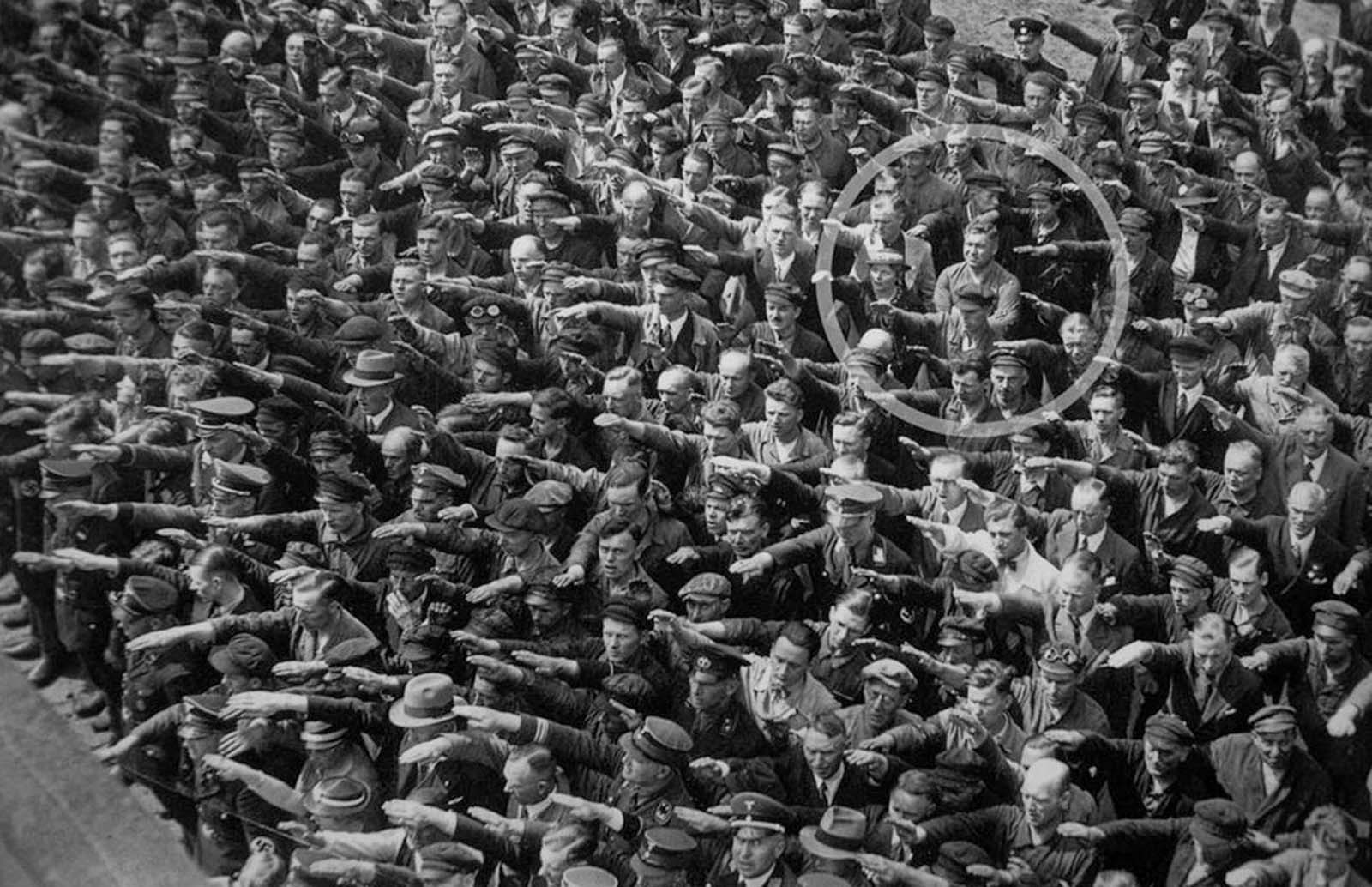
Letting “feelings” trump biological facts is not just a philosophical concern. As Postmodernism grows in influence, caring about facts becomes a secondary (or tertiary) issue... A number of years ago, reflecting on the possible repercussions of postmodern thought the British anthropologist Ernest Gellner observed (1992/1999: 93) :
"Quite probably, the break-through to the scientific miracle was only possible because some men were passionately, sincerely, whole-heartedly concerned with Truth. Will such passion survive the habit of granting oneself different kinds of truth according to the day of the week?"
If reason and logic (even mathematics...) are no more than arbitrary cultural conventions (as postmoderns assert), such a statement brings into question the whole concept of the university, a haven for universal knowledge, which is, ironically, the postmoderns favourite refuge. There is another piece of the puzzle that needs attention. If one accepts the postmodern worldview as a reaction to the Judeo-Christian world-view, then one must account for the fact that with few exceptions, Christians get their moral law from Judaism, more specifically Moses. The other factor is that about 2/3rds of the Christian Bible comes from the Jews. This explains why postmoderns so naturally slip into Jew-Hatred (Anti-Semitism). But being a hypocritical sect, postmoderns frame their prejudices as a "political opinion", that is using the expression "Anti-Zionism". The end result is that Jew-Hatred is just as popular in 2026 as it was in the 1930s...
We shouldn’t be too surprised by the blatant Jew-Hatred expressed on university campuses in the West. This is NOT about “politics”. This is inevitably linked to the postmodern worldview that has been preached in these institutions for at least a generation now. Postmodernism asserts that all religions are equal, that “truth” is nothing more than a cultural construct and that the individual is accountable to no one. Postmoderns especially HATE the concept of judgement, the idea that SomeOne has something to say about my behaviour, attitudes, sex life or intellectual life. This of course is in violent contradiction with Judaism, and in particular with the Ten Commandments written by God and handed down by Moses, which state that all will be judged before God and will be held accountable. This conflict is therefore deeply spiritual, as (liberal catholic author) Thomas Cahill pointed out (1998: 152-153)
A good case can be made that medieval anti-Hebraism and its modern offspring anti-Semitism are both forms of God-hatred, masquerading as self-justifying intolerance. The hatred of Christians for Jews may have its ultimate source in hatred of God, a hatred that the hater must carefully keep himself from knowing about. Why would one hate God? To find the answer we probably need look no further that the stark, unyielding Ten [Commandments].
And if Cahill’s comment applies to Christians of the past who persecuted the Jews, it applies even more so to postmodern elites who absolutely HATE the idea that we shall all be accountable to the Great Lawgiver. This is intolerable heresy in postmodern eyes...
Concluding remarks
In chapter 10 of MacIntyre's book he asserts (referring to the work of another MacIntyre, that is Alasdair MacIntyre and his book After Virtue) that the fall of Total State is inevitable, as if it was a physical process comparable to gravity.
As ideological purity becomes more and more enforced by the Total State, creativity is excluded and stupidity becomes institutionalized. But this seems to me to be a copout to avoid doing the work to analyse the ideological forces driving the situation. While asserting the inevitability of the downfall of the Total State Auron M is realistic (page 149) about the fact that a totalitarian regime can operate for long periods of time. It probably would not have been a good idea to console Russians in 1917 by telling them that the Soviet totalitarian regime would inevitably fall. To survive, they would have to find hope elsewhere...
While institutionalized stupidity may contribute to the downfall of a Total State, history tells us that arrogance may also be a significant factor as well. Looking back to the beginning of the year 1941, Nazi Germany occupied almost all of Europe. Only England held out any resistance and Germany had an ally to the East in Stalin's Soviet regime that had its back. Up until that point, the Nazi army had won battle after battle. With few exceptions, things had always gone Hitler's way. On 22 June 1941 Hitler made the stupidest decision of the war, launching Operation Barbarossa and attacked Russia. As result, Hitler gained a new and determined enemy that would significantly contribute to the downfall of the Nazi regime. Had he cancelled this initiative, Europe might still be Nazi-occupied...
* quotes followed by an asterisk are my translations.
--- (2020) Press File on Neototalitarianism. (Samizdat) -> French and English articles
Amundson, Quinton (2026) Liberals, Bloc force Bill C-9 through. (The Catholic Register - 10/3/2026) -> Canadian Hate Speech bill
Anonymous (1940) German Martyrs. Time magazine 23 Dec., vol. 36 n° 26 pp. 38-41
Anonymous (2026) Legal Definitions: Social Justice. (Rochby LawOffice - 17/3/2026)
Arendt, Hannah (1948/1976) The Origins of Totalitarianism. Harvest Book New York xliii-576 p.
Bauerlein, Mark (2026) Why Leftists Love Tyranny (interview with Jamie Glazov). (First Things - PodCast, 31 minutes - 15/5/20226)
Berkemeyer, Drew (2026) Dem-Owned Brewery Promising 'Free Beer Day' If Trump Is Murdered Whines About Failed Attack A former candidate for Wisconsin State Assembly, Kirk Bangstad has a history of controversial and divisive speech. (DailyWire - 26/4/2026)
Burmawi, Danny (2026) Sovereign Gods, Free Men: American Exceptionalism Against The Caliphate Every other political order in history failed to deliver what the American political order delivered. (DailyWire - 24/8/2026)
Cahill, Thomas (1998) The Gifts of the Jews: How a Tribe of Desert Nomads Changed the Way Everyone Thinks and Feels. Nan a Talese/Doubleday New York 291 p.
Chomsky, Noam. (2005) “On Historical Amnesia, Foreign Policy, and Iraq.” American Amnesia: Noam Chomsky interviewed by Kirk W. Johnson.
Dawkins, Richard (1986) The Blind Watchmaker. Norton New York xiii - 332 p.
de Beauvoir, Simone (1981) La cérémonie des adieux; suivi de Entretiens avec Jean-Paul Sartre, août-septembre 1974. [Paris]: Gallimard, 559 p.
Dostoyevsky, Fyodor (1880) The Brothers Karamazov. Translated from the Russian by Constance Garnett The Lowell Press New York Ebook
Eliot, T. S. (1991/1965) To Criticize the Critic and Other Writings. Bison Books [New York] 189 p.
Evangelical Fellowship of Canada (2025) Bill C-9: Combatting Hate Act. (6/10/2025)
Foran, Charles (2017) The Canada experiment: is this the world's first 'postnational' country? (The Guardian – 4/1/2017)
Gellner, Ernst (1992/1999) Postmodernism, Reason and Religion. Routledge London/New York 108p.
Gosselin, Paul (1979) Myths of Origin and the Theory of Evolution. Samizdat
Gosselin, Paul (1986) Article reviews on the New (scientific) Priesthood by Eileen Barker. Samizdat
Gosselin, Paul (2012) Flight From the Absolute: Cynical Observations on the Postmodern West. Volume I . Samizdat ix - 412 p
Gosselin, Paul (2020) A Note on US political derangement... (A Canadian Angle). (Samizdat - Sept. 2020)
Gosselin, Paul (2022) Alasdair MacIntyre (1981) After Virtue: A book review. (Samizdat - 25/4/2022)
Gosselin, Paul (2023) A Brief Note on Universities as Propaganda Machines. (Samizdat - 25/7/2023)
Gosselin, Paul (2024) La Tentation totalitaire par Jean-François Revel. (Samizdat - 13/9/2024)
Gosselin, Paul (2025) Cahn's The Return of the Gods: A review. (Samizdat - 25/12/2025)
Gosselin, Paul (2026) Postmodernism as a Worldview: A nutshell perspective. (Samizdat - 3/4/2026)
Grassé, Pierre-Paul (1980) L'Homme en accusation_: De la biologie à la politique. Albin Michel Paris 354 p.
Hammer, Josh (2026) Leftist Political Violence is an Existential Threat to the Republic Enough is enough. (FrontPage - 29/4/2026)
Huxley, Aldous (1958/2007) Brave New World Revisited. Vintage Canada xvi - 407 p.
Huxley, Julian Sorell (1946) UNESCO: Its Purpose and Its Philosophy. Preparatory Commision of the United Nations Educational and Scientific and Cultural Organisation. - C/6 15 September 1947. Public Affairs Press, Washington. 62 p.
Klatzkin, Shmuel (2026) Higher Law and Human Law: The Religious Roots of American Freedom - From Martin Luther King Jr. to James Madison, liberty rests on a law above the state. (The American Spectator - 2/5/2026)
Lancefield, Paul (2024) Fascism 2.0 – The changing face of social media censorship AI-driven content moderation is subtly shaping public opinion and political engagement. (Off-Guardian - 21/8/2024)
Lewis, Clive Staples (1942/1974) The Screwtape Letters. Collins London & Glasgow (coll. Fontana) 160 p. Samizdat Ebook
Lewis, Clive Staples (1945/2015) That Hideous Strength. Samizdat Ebook
Lewis, Clive Staples (1947/2002) The Humanitarian Theory of Punishment. chap. 4 in God in the Dock. (Walter Hooper ed.). Eerdmans Grand Rapids MI 347 p.
Lewis, Clive Staples (1955) Surprised by Joy. Harcourt Brace Jovanovich New York 238 p.
Lewis, Clive Staples (1959/2014) Screwtape Proposes A Toast. Samizdat - 16p. Ebook
Lewis, Clive Staples (1960/1987) The World's Last Night and other Essays. Harvest New York 113 p.
Lewis, Clive Staples (1986) Present Concerns: Essays by CS Lewis. Harvest/Harcourt New York London 108 p.
Luckmann, Thomas (1970) The Invisible Religion. MacMillan New York 128 p.
MacIntyre, Auron (2024) The Total State: How Liberal Democracies Become Tyrannies. Regnery New York 184 p.
MacIntyre, Auron (2024b) Post. (X - 24/6/2024)
McGrogan, Dr David (2023) Should We Be Worried That Over a Third of Young People Want to Live Under a Dictatorship? (Daily Sceptic - 19/12/2023)
McKenzie, Lisa (2023) Orwell would loathe today's left: He slammed the bourgeois intellectuals of his day for their intolerance and insularity. Sound familiar? (Spiked – 14/9/2023)
Muggeridge, Malcom (1977/1978) Christ and the Media. Eerdmanns Grand Rapids MI (coll. London Lectures in Contemporary Christianity) 127 p.
Nietzsche, Friedrich (1886) Beyond Good and Evil. (Project Gutenberg)
Nietzsche, Friedrich (1895) Twilight of the Idols. (translation by Walter Kaufmann and R.J. Hollingdale)
Nietzsche, Friedrich (1901/1913) Will to Power: An Attempted Transvaluation of All Values. vol. II. [Translator:, Anthony M. Ludovici] TN Foulis London xx-432 p.
Orwell, George (1949/2020) Nineteen Eighty-Four. Samizdat Ebook 258 p.
Phillips, Melanie (2026) 'We're told that all the West does is evil – and all our enemies do is good': On how 'progressives' came to side with Islamist brutality. (Spiked - 7/4/2026)
Provine, William B. (1994) Darwinism: Science or Naturalistic Philosophy? A debate between William B. Provine and Phillip E. Johnson at Stanford University, April 30, 1994
Rainsborough, Michael (2025) Towards Post-totalitarianism in the West: Some Warnings From the East. (Daily Sceptic – 2/2/2/2025)
Rivera, Julio (2026) The new censorship doesn't say 'no' — it says 'no one can see it'. (Blaze News - 17/3/2026)
Roberts, Paul Craig (2024) The Western World Has Succumbed to Tyranny. (Zero Hedge - 22/8/2024) -> British journalist arrested in the UK for his journalism...
Sade, Marquis de; & Blanchot, Maurice (1795/1972) Français, encore un effort si vous voulez être républicains. (extrait de La Philosophie dans le boudoir”) précédé de L'inconvenance majeure. Jean-Jacques Pauvert Paris (collection Libertés nouvelles; 23) 163 p. (has been translated, Philosophy in the Bedroom)
Salllust (2026) Why The Left is More Distressed, Anxious and Filled With Hate Than the Right. (Daily Sceptic - 17/3/2026)
Solzhenitsyn, Aleksandr; Agursky, Mikhail; Evgeny Barabanov, A. B.; Borisov, Vadim; Korsakov, F.; Shafarevich, Igor (1974/1981) From Under the Rubble. Regnery Gateway Chicago IL xii-308 p.
Solzhenitsyn, Aleksandr (1983) Godlessness: the First Step to the Gulag. Templeton Prize Lecture, 10 May 1983 (London)
Szpilman, W_adys_aw (1946/2002) The Pianist: The Extraordinary True Story of One Man's Survival in Warsaw, 1939-1945. Weidenfeld & Nicolson London 222 p.
Snider, Chenyuan (2026) I Came From China — And I've Seen How This Ends For America: America is great because for many decades her immigrants came from a similar cultural background that bore a heavy Christian influence. (DailyWire – 28/2/2026)
Thunder, David (2026) Spain's New "Hate and Polarisation Footprint" Has a Strong Whiff of Totalitarianism. (The Freedom Blog - 20/3/2026)
Tillman, John (2026) How The Left Threatens Citizens Instead of Pressuring Politicians to Achieve Its Goals. (The Federalist – 6/3/2026)
Toto, Christian (2026) 'BURN IT ALL DOWN': Firebrand feminist filmmaker calls for violent revolution. (Blaze News - 1/8/2026)
Turley, Jonathan (2026) Assassination Sing-a-Long: Hasan Piker Mocks the Murdered Charlie Kirk to Cheering Crowd. (23/8/2026)
Vonnegut, Kurt Jr. (1975) Wampeters, Foma & Granfalloons, Dell Publishing Co. Inc, New York 238 p.
Wheeler, Liz (2026) Liz Wheeler drops shocking poll that should terrify every conservative after WHCD assassination attempt. (Blaze News - 29/4/2026)
Zindulka, Kurt (2024) Atheist Richard Dawkins Says He Would Choose Christianity over Islam ‘Every Single Time', Calls Himself a ‘Cultural Christian'. (Breitbart - 1/4/2024)
An Out-dated Dichotomy... (“Left” vs “Right” politics)
Like many American thinkers, MacIntyre seems stuck in the 20th century, still taking about “Left” and “Right” political views as if these were still significant terms. In my view, still referring to this dichotomy is accepting to wear a 20th century intellectual straightjacket.
In United States, when an activist or political figure is described as "left-wing," it often means nothing specific ideologically. In the early 20th century this term was specific and had some bite. Being on the left implied admiring communism, that is, someone believing in the overthrow of capitalism in order to establish the paradise of the dictatorship of the proletariat. Igor Shafarevich, the Russian dissident and historian of socialism makes this critical point about socialism (1974/1981: 28)
The primacy of economic demands among the basic principles of socialism is also emphazied in The Communist Manifesto of Marx and Engels: "... Communists can state their theory in one proposition: the destruction of private property.."
In the same essay, Shafarevich goes on to other central dogmas that play a part in socialism noting (1974/1981: 31)
So, among the principles which are present in many unconnected socialist states, or present-day movements and which can therefore be attributed to the basic premises of socialism, are: the abolition of private property[14a], the destruction of religion, the destruction of the family. Socialism appears before us not as a purely economic concept, but as an incomparably wider system of views, embracing almost every aspect of human existence. [as religion or worldview does, PG]
In 2026, too often those whom Americans call "left-wing" are NOT proletarians intent on bringing down capitalism, but in fact may be very successful capitalists or simply those who have successfully undergone a university brainwashing and who openly despise the workers they previously identified with... Typically these lean towards progressive/postmodern[15] ideologies, therefore reject any vestige of Judeo-Christian beliefs... So while present-day postmoderns have dropped the abolition of private property, the do share with the socialists of the past, the objectives of the destruction of religion and the destruction of the family. That said, in the West, campaigns for the destruction of religion typically target any vestige of judeo-christian belief. Islam is typically considered an ally by postmoderns in this game.
In present discourse, labelling an individual or organisation as "left-wing" now typically indicates that this individual or organisation believes that political salvation lies in an omnipresent State that fixes every problem (eventually leading to a State that controls EVERYTHING), or that these individuals or organisations may criticize traditional American values (or are openly anti-Christian). In my view Americans would be better off dropping the term "Left", but this is probably unlikely as the Right/Left dichotomy has become deeply entrenched in American intellectual culture and breaking free would require serious intellectual work, despite the fact that this effort would lead to a clearer understanding of the present situation, identifying more clearly who are the adversaries of democracy and enabling understanding of the worldview/ideology that drives their attitudes and behaviour. Clearly CS Lewis was rather cynical about the political landscape in the West and "Left/Right" dichotomy in particular. In his 1945 novel, That Hideous Strength, Lewis has the Miss Hardcastle character saying (1945/2015: 87)
"Don't you understand anything? Isn't it absolutely essential to keep a fierce Left and a fierce Right, both on their toes and each terrified of the other? That's how we get things done. Any opposition to the N.I.C.E. is represented as a Left racket in the Right papers and a Right racket in the Left papers. If it's properly done, you get each side outbidding the other in support of us — to refute the enemy slanders. Of course we're non-political. The real power always is."
While it is true that postmoderns love Big Government, postmodern neototalitarians have taken this a step further. The Davos pawns in power in most Western nations are not satisfied with power over one State. They want more power. They are committed to the idea of World Power. This thirst for total power is frequently expressed in negative terms, that is via their distain of expressions of nationalism or patriotism. While fascists of the 1930s were staunch nationalists, postmodern elites and the Davos puppets currently in power in the West have nothing but contempt for any nationalist or popular movements. This explains the deluge of postmodernist contempt for 'Make America Great Again', for Brexit, for flag-waving Britons, for the French “gilet jaunes” or Justin Trudeau's contempt for Canadian truckers waving Canadian flags (and flouting his vaccine decrees). This is a significant pattern... In Europe, this goes further, to the point of attempts at outlawing nationalist political parties in France and Germany or having courts cancel elections in Romania that don't go the right way. The flip side (or source) of this is an elitist ideology that despises democracy, the voice of the people, the masses who should know when to shut up and do what they're told...
The neototalitarian postmodern trend among Davos pawns also explains statements such as those by Canadian prime minister, Justin Trudeau, who in 2015 told the New York Times that Canada could be the “first in postnational state”, adding “There is no core identity, no mainstream in Canada.” Since this implies that because Canada has "no voice" (and no national character or culture), then this is an indication that Davos puppets such as Trudeau, feel it is their right to TOTALLY disregard what Canadians want or express and subsequently manipulate or coerce the Canadian population into the cattle trains they have prepared for them. But once one determines to ignore Davos Newspeak and look at what they do (actual policies affecting citizens), Davos puppets' are in fact neototalitarian, with no regard for citizen's rights. One trick to discredit nationalist movements is to automatically label them "extreme right", which is basically a meaningless expression except for the fact that those using it express their desire to discredit and shut down the voice of the people. This is the hypocritical face of the postmodern Inquisition. Postmoderns, for all their talk about "tolerance" and "inclusion", are intrinsically elitist and intolerant, despising the people's voice.
Today, those deemed to be on the "Left" no longer want to overthrow capitalism, for the simple reason that woke capitalists are often their best friends and they have nothing but CONTEMPT for workers. On the other hand, capitalists can often be induced to behave like the Stasi and (who knows?) might even be up for setting up a Gulag if the price is right. Do I exaggerate? Hey, does the "15 Minute City" ring a bell? Yes, if the Davos pawns get their way, we can all have our own personal Warsaw Ghetto while our technocratic overlords enjoy themselves as they micromanage the herd... Well, it's true that restrictions and deprivations are no longer put forward under the pretext of “building a classless society." In 2026, the propaganda trick is to say restrictions and deprivations are necessary “for the environment”, "to flatten the curve" or to "save the planet." This justifies the worst forms of oppression (and ALL taxes)... After all, WHO would dare question "saving the planet"? So our yacht-owning and jet-setting elites guilt-monger us about “reducing our carbon imprint”, while forgetting (?) that we are mainly carbon ourselves...
[1] - Accomplished pharma prof thrown in psych hospital after questioning official COVID narrative: Early on December 10, Jean-Bernard Fourtillan was taken from his home by a team of French law enforcement officers and forcibly placed in solitary confinement at the psychiatric hospital of Uzès. (Jeanne Smits - LifeSite – 11/12/2020)
And this was not an isolated incident, but occured elsewhere in Europe
Norway LOCKED Man in Psychiatric Ward for Questioning mRNA Shots. (Peter Imanuelsen - The Gateway Pundit - 24/8/2023)
This is a concept that CS Lewis had given some thought to, that is that therapy could become a legal weapon. In an article entitled The Humanitarian Theory of Punishment (1947, republished in God in the Dock), C.S. Lewis made the following observations (1947/2002: 287-288)
According to the Humanitarian theory, to punish a man because he deserves it, and as much as he deserves, is mere revenge, and, therefore, barbarous and immoral. It is maintained that the only legitimate motives for punishing are the desire to deter others by example or to mend the criminal. When this theory is combined, as frequently happens, with the belief that all crime is more or less pathological, the idea of mending tails oil into that of healing or curing and punishment becomes therapeutic. Thus it appears at first sight that we have passed from the harsh and self-righteous notion of giving the wicked their deserts to the charitable and enlightened one of tending the psychologically sick. What could be more amiable? One little point which is taken for granted in this theory needs, however, to be made explicit. The things done to the criminal, even if they are called cures, will be just as compulsory as they were in the old days when we called them punishments. If a tendency to steal can be cured by psychotherapy, the thief will no doubt be forced to undergo the treatment. Otherwise, society cannot continue.
My contention is that this doctrine, merciful though it appears, really means that each one of us, from the moment he breaks the law, is deprived of the rights of a human being.
The reason is this. The Humanitarian theory removes from Punishment the concept of Desert. But the concept of Desert is the only connecting link between punishment and justice. It is only as deserved or undeserved that a sentence can be just or unjust. I do not here contend that the question Is it deserved?' is the only one we can reasonably ask about a punishment. We may very properly ask whether it is likely to deter others and to reform the criminal. But neither of these two last questions is a question about justice. There is no sense in talking about a 'just deterrent' or a 'just cure'. We demand of a deterrent not whether it is just but whether it will deter. We demand of a cure not whether it is just but whether it succeeds. Thus when we cease to consider what the criminal deserves and consider only what will cure him or deter others, we have tacitly removed him from the sphere of justice altogether; instead of a person, a subject of rights, we now have a mere object, a patient, a 'case'.
In the same article, Lewis explores how such views could play out for Christians, or for any other dissidents (1947/2002: 293)
We know that one school of psychology already regards religion as a neurosis. When this particular neurosis becomes inconvenient to government, what is to hinder government from proceeding to 'cure' it? Such 'cure' will, of course, be compulsory; but under the Humanitarian theory it will not be called by the shocking name of Persecution. No one will blame us for being Christians, no one will hate us, no one will revile us. The new Nero will approach us with the silky manners of a doctor, and though all will be in fact as compulsory as the tunica molesta or Smithfield or Tyburn, all will go on within the unemotional therapeutic sphere where words like 'right' and 'wrong' or 'freedom' and 'slavery' are never heard. And thus when the command is given, every prominent Christian in the land may vanish overnight into Institutions for the Treatment of the Ideologically Unsound, and it will rest with the expert gaolers to say when (if ever) they are to re-emerge. But it will not be persecution. Even if the treatment is painful, even if it is life-long, even if it is fatal, that will be only a regrettable accident; the intention was purely therapeutic. In ordinary medicine there were painful operations and fatal operations; so in this. But because they are 'treatment', not punishment, they can be criticized only by fellow-experts and on technical grounds, never by men as men and on grounds of justice.
[2] - CS Lewis was well aware of the consequences of such a strategy and in an article entitled Modern Man and His Categories of Thought discussed how agendas in education cut off modern man from wisdom and works by the ancients (1986).
A revolution in the education of the most highly educated classes. This education was formerly based throughout Europe on the Ancients. If only the learned were Platonists or Aristotelians, the ordinary aristocrat was a Virgilian or, at the very least, a Horatian. Thus in Christian and skeptic alike there was a strong infusion of the better elements of Paganism. Even those who lacked piety had some sympathetic understanding of 'pietus'. It was natural to men so trained to believe that valuable truth could still be found in an ancient book. It was natural to them to reverence tradition. Values quite different from those of modern industrial civilization were constantly present to their minds. Even where Christian belief was rejected there was still a standard against which contemporary ideals could be judged. The effect of removing this education has been to isolate the mind in its own age; to give it, in relation to time, that disease which, in relation to space, we call Provincialism. The mere fact that St Paul wrote so long ago is, to a modern man, presumptive evidence against his having uttered important truths. The tactics of the enemy in this matter are simple and can be found in any military text book. Before attacking a regiment you try, if you can, to cut it off from the regiments on each side.
[3] - As the reader can observe, postmodern attempts at cultural terraforming are alive and well...
Stop trying to race-swap Shakespeare : I cannot believe it needs to be said but the Bard was not ‘a black woman'. (Simon Evans – Spiked – 1/2/2026)
How universities went to war with biological facts: Alice Sullivan on the suppression of gender-critical research. (Spiked - 6/7/2025)
The arts are being smothered by self-censorship The 'creative' sector has become a hostile environment for new, challenging and controversial ideas. (Rosie Kay - Spiked - 24/6/2025)
Why did a Brussels bookshop cancel my book launch? The capital of the EU has become a no-go zone for dissent. (Frank Furedi - Spiked - 26/9/2024)
Libraries are being destroyed from within: The public does not need protection from 'problematic' texts. (Frank Furedi - Spiked - 30/10/2023)
My Response to Rules I Don't Accept is to Break Them. (Lionel Shriver - Daily Sceptic - 25/10/2023) -> a novelist rants about the Woke Inquisition...
Ian McEwan is right to take on the sensitivity readers: A fear of causing offence is the enemy of artistic freedom. (Nick Tyrone - Spiked - 18/10/2023)
The neutering of Monty Python: Trans activists are even more censorious than fundamentalist Christians. (Simon Evans - Spiked - 24/5/2023)
Author Salman Rushdie warns that West is closing in on free speech. (Tom Howell Jr. - The Washington Times - 16/5/2023)
Picasso and the arrogance of the new censors: The cultural elite has no right to tell us what art we can enjoy. (Darragh McManus - Spiked - 17/4/2023)
Agatha Christie's classic detective novels edited to remove potentially offensive language. (Toyin Owoseje – CNN – 27/3/2026)
CS Lewis, Tolkien, Orwell among works tagged as triggers for 'far-right' extremism by anti-terrorism group: Author Douglas Murray said 'dogmatic' attitude of UK elites has also infected US. (Jon Brown - Fox News - 28/3/2023) -> all of which raises the question: On which ideologico-religious system is this UK anti-terrorism unit (Prevent) using as a basis to determine what "extremism" is???
Roald Dahl Books Get New Edits—And Critics Cry Censorship: The Controversy Surrounding ‘Charlie And The Chocolate Factory' And More. (Marisa Dellatto – Forbes – 20/2/2023)
Big Tech and the Erasure of History: The censorship of the tech thought police is a huge problem. (Bill Muehlenberg - CultureWatch - 12/9/2022)
Now they want to ‘decolonise' Shakespeare : The Globe's plan to tackle the ‘problematic' aspects of Shakespeare is deeply philistine. (Ella Whelan - Spiked – 25/5/2021)
Amazon: from book-selling to book-burning: Its decision to stop selling a book criticising transgenderism is part of an alarming trend. (Tim Black - Spiked - 9/3/2021)
Kazuo Ishiguro is right: cancel culture kills creativity: The Nobel-winning author says young writers are self-censoring out of fear of the online 'lynch mob'. (Spiked - 1/3/2021)
Erasing classic literature for kids. (John Kass - Chicago Tribune - 9/2/2021)
Rowan Atkinson, Star of ‘Mr. Bean,' Condemns Cancel Culture: A ‘Medieval Mob Looking For Someone to Burn'. (Paul Bois - DailyWire - 5/1/2021)
Policing language, controlling thought?: We must resist the attempts to manipulate the meaning of the words we use. (Andrew Doyle - Spiked - 21/8/2020)
[4] - As well as the inevitably humongous amounts of cash being spent worldwide to push this sexual ideology forward.
[5] - On balance, not all German Christians stood by and watched. Interviewed in 1940 Albert Einstein observed (Anonymous 1940 : 38):
Being a lover of freedom, when the (Nazi) revolution came, I looked to the universities to defend it, knowing that they had always boasted of their devotion to the cause of truth; but no, the universities were immediately silenced. Then I looked to the great editors of the newspapers, whose flaming editorials in days gone by had proclaimed their love of freedom; but they, like the universities, were silenced in a few short weeks.... Only the Church stood squarely across the path of Hitler's campaign for suppressing truth. I never had any special interest in the Church before, but now I feel a great affection and admiration for it because the Church alone has had the courage and persistence to stand for intellectual and moral freedom. I am forced to confess that what I once despised I now praise unreservedly.
[6] - It turns out that, as French biologist P.-P. Grassé noted, universities offered no intrinsic obstacle to totalitarian temptations (1980: 44):
After the [1933] triumph of National Socialism, German science provided massive unconditional backing to the Führer. Anthropologists, geneticists, economists and lawyers began zealously serving their new master. [Grassé adds in a footnote at the bottom of the page [2] – PG]: German intellectuals' support to their Führer was substantial. During the 1933 referendum, statements by university professors were collected in one volume. Among the authors of these texts one encounters the famous philosopher Martin Heidegger, which is both surprising given the idealism that permeates his work and revealing of the mind-set that gave Hitler such a victory.*
[7] - And whistleblower regarding the 1930s Ukrainian Holodomor ordered by Stalin to eliminate counter-revolutionary elements.
[7a] - Here is a further piece that could be added to the puzzle regarding a linkage between totalitarianism and secret societies. In a collection of essays edited by Alexandr Solzhenitsyn, the Russian dissident and historian of socialism Igor Chafarevitch relates the following anecdote which occured in pre-Revolutionary France (in Solzhenitsyn 1974/1981: 43-44)
In 1786 in Paris a secret society called the "Union of the Equal" was founded with the aim of preparing a revolution. The plot was discovered and its participants arrested, but their plans have been preserved in detail, thanks to the documents published by the government and to the memoirs of the plotters who survived. Among the aims which the plotters had set themselves. The first was the abolition of private property. The whole French economy was to be fully centralized. Trade was to be suspended and replaced by a system of state provisioning. All aspects of life were to be controlled by a bureaucracy: "The fatherland takes possession of a man from the day of his birth and does not let him go until his very death." Every man was to be regarded to some extent as an official supervising both his own behavior and that of others. Everybody was to be obliged to work for the state, while the "the uncooperative, the negligent, and people who lead dissolute lives or set a bad example by their absence of public spirit" were to be condemned to forced labor. For this purpose many islands were to be turned into strictly isolated places of confinement. Everybody was to be obliged to eat in communal refectories. Moving about the country without official permission was to be forbidden. Entertainments which were not available to everyone were categorically forbidden. Censorship was to be introduced and publications of "falsely denunciatory character" were forbidden.
[8] - The materialism MacIntyre alludes to here is not the only option on the table. Postmodernism opens other metaphysical doors. But more on that below...
[9] - Oddly enough, in an unguarded moment, this was something admitted to by the French Existential philosopher Jean-Paul Sartre (in de Beauvoir 1981: 552)
S. de B. - In general terms how would you define Good and Evil, at least what you call Good or Evil?
J.-P. S. - Essentially Good is that which serves human freedom, allowing it to place the objects it has made, and Evil is that which obstructs human freedom, that which presents man as not free, creating the determinism that sociologists [promoted] some time ago.
S. de B. - So your morality is based on man and has nothing much to do with God.
J.-P. S. - None, now. But certainly concepts of absolute Good and Evil are derived from the catechism I was taught [when I was young].*
[10] - CS Lewis observed in his autobiography (Surprised by Joy), that shortly after WWI when he began his university studies little had changed since Nietzsche's initial observations (1955 : 209-210)
But there were in those days all sorts of blankets, insulators, and insurances which enabled one to get all the conveniences of Theism, without believing in God. The English Hegelians, writers like T. H. Green, Bradley, and Bosanquet (then mighty names), dealt in precisely such wares. The Absolute Mind — better still, the Absolute — was impersonal, or it knew itself (but not us?) only in us, and it was so absolute that it wasn't really much more like a mind than anything else. And anyway, the more muddled one got about it and the more contradictions one committed, the more this proved that our discursive thought moved only on the level of "Appearance", and "Reality" must be somewhere else. And where else but, of course, in the Absolute? There, not here, was "the fuller splendour" behind the "sensuous curtain". The emotion that went with all this was certainly religious. But this was a religion that cost nothing. We could talk religiously about the Absolute: but there was no danger of Its doing anything about us. It was "there"; safely and immovably "there". It would never come "here", never (to be blunt) make a nuisance of Itself. This quasi-religion was all a one-way street; all eros (as Dr. Nygren would say) steaming up, but no agape darting down. There was nothing to fear; better still, nothing to obey.
[11] - This comment leads me to believe that Nietzsche may have been aware of David Hume's is/ought paradox. Basically what this means is that you cannot get moral duties (ought) from observable facts (is).
[12] - Or the Siècle des Lumières as the French would say.
[13] - CS Lewis, in an article initially published in 1952, recognized the ideological source of Darwinism and stated (1960/1987: 103):
... the attraction of Darwinism was that it gave to a pre-existing myth the scientific reassurances it required. If no evidence for evolution had been forthcoming, it would have been necessary to invent it. The real sources of the myth are partly political. It projects onto the cosmic screen feelings engendered by the Revolutionary period.
[14] - A lot of superficial “Evangelical” Self-fulfilment, blessing theology is then just repackaged postmodernism.
[14a] - But then again, the Davos sect would seem to go this extra mile and abolish private property, at least for the masses... Remember their disgusting meme: "You'll own nothing and be happy" [while we laugh all the way to the bank]?? Might this be only a very thinly disguised reintroduction of slavery? After all, slaves are not supposed to own anything, only be owned...
[15] - The progressive/postmodern ideology is commonplace in Silicon Valley and in the Hi Tech industry. Regarding the term "progressive”, John Tillman exposes the totalitarian undercurrent in this movement (2026)
“Progressive” shouldn't be a bad word. We all welcome technological, medical, and scientific innovations that help human beings to live longer and more comfortable lives. We all dream of better lives for our children. In that sense, we are all progressives. Of course, that's not how contemporary “progressives” understand the concept. Their goal isn't to encourage innovation and invention. Their goal is to coerce and compel individual Americans to live according to a particular set of collectivist, secular values. For these elites, progress is defined not by human flourishing, but by human submission to an all-powerful, all-knowing state. It is not government by the people. It is government for the people as the government believes the people should be.